“Free the child’s potential and you will transform him into the world” – Maria Montessori
Montessori’s Origins
More than a century ago, Dr. Maria Montessori—Italy’s first female physician—launched an educational movement that continues to shape classrooms around the world. Her pioneering work created a framework for helping all children, from gifted learners to those with learning differences, become self-motivated, independent, lifelong learners.
The Prepared Environment
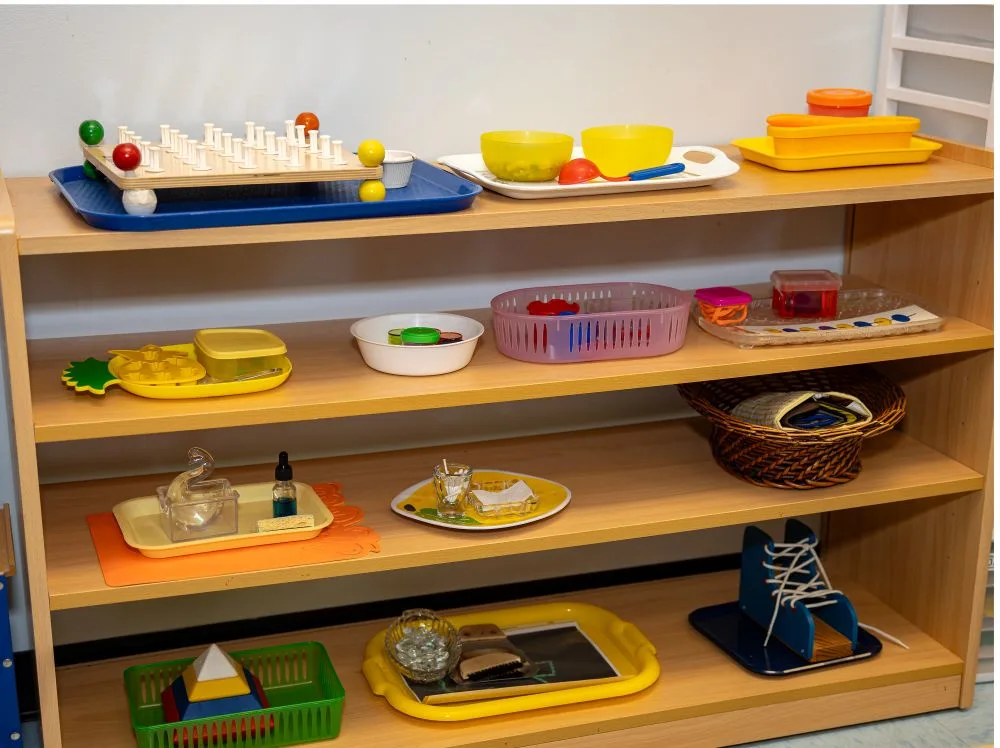
A hallmark of the Montessori approach is the prepared classroom environment. Based on Dr. Montessori’s belief that children learn best through self-directed discovery, the classroom is intentionally designed to offer a range of developmentally appropriate activities that children can choose independently.
Each classroom includes hands-on materials that allow children to learn at their own pace. Through these activities, they build problem-solving skills, recognize connections across subjects, and develop practical life skills that support imaginative thinking. Montessori believed this kind of environment nurtures both independence and a lasting love of learning.
Mixed-Age Classrooms and Individualized Learning
Montessori classrooms bring children of different ages together, creating a community in which older students naturally guide and support younger ones. As they gain independence, older children learn to take responsibility not only for themselves but also for helping others. This dynamic encourages patience, compassion, leadership, and confidence as children grow into positive role models.
Montessori education also emphasizes learning through all five senses. Children progress at their own pace and choose from a wide range of meaningful activities, allowing them to explore concepts in ways that match their interests and developmental stage. This hands-on approach helps children build understanding through direct experience and develop a stronger sense of how they relate to the world around them.
Grace and Courtesy
Montessori education is designed to respect each child’s individual learning style and support long-term success. Because no two children learn in exactly the same way, the curriculum is flexible and responsive, allowing each child to progress through meaningful, personalized experiences.
Childhood is a time of openness, creativity, and growth. Montessori education nurtures the whole child, helping children learn to care for themselves, their environment, and one another while developing kindness, responsibility, and a sense of peaceful citizenship.
“We discovered that education is not something the teacher does, but a natural process that develops spontaneously in the human being.” — Maria Montessori
Benefits of Montessori Education
Montessori education respects each child’s individual learning style and supports long-term success through a flexible, responsive curriculum.
Children learn through all five senses and progress at their own pace, choosing from a wide range of meaningful, hands-on activities.
Mixed-age classrooms create supportive communities where older children naturally guide younger ones and develop leadership skills.
Montessori nurtures the whole child, encouraging independence, responsibility, kindness, and care for others and the environment.
Notable Montessori Alumni
Sergey Brin and Larry Page — founders of Google
Katharine Graham — publisher of The Washington Post
Prince William and Prince Harry — members of the British royal family
Julia Child — chef, television personality, and author